Model Integrated Evidence
Generating evidence from the science of Model Informed Drug Development (MIDD)

Improved decision making; accelerated development timelines and cost efficiency gains through FDA accepted mathematical and statistical modelling.
Accelerated Development
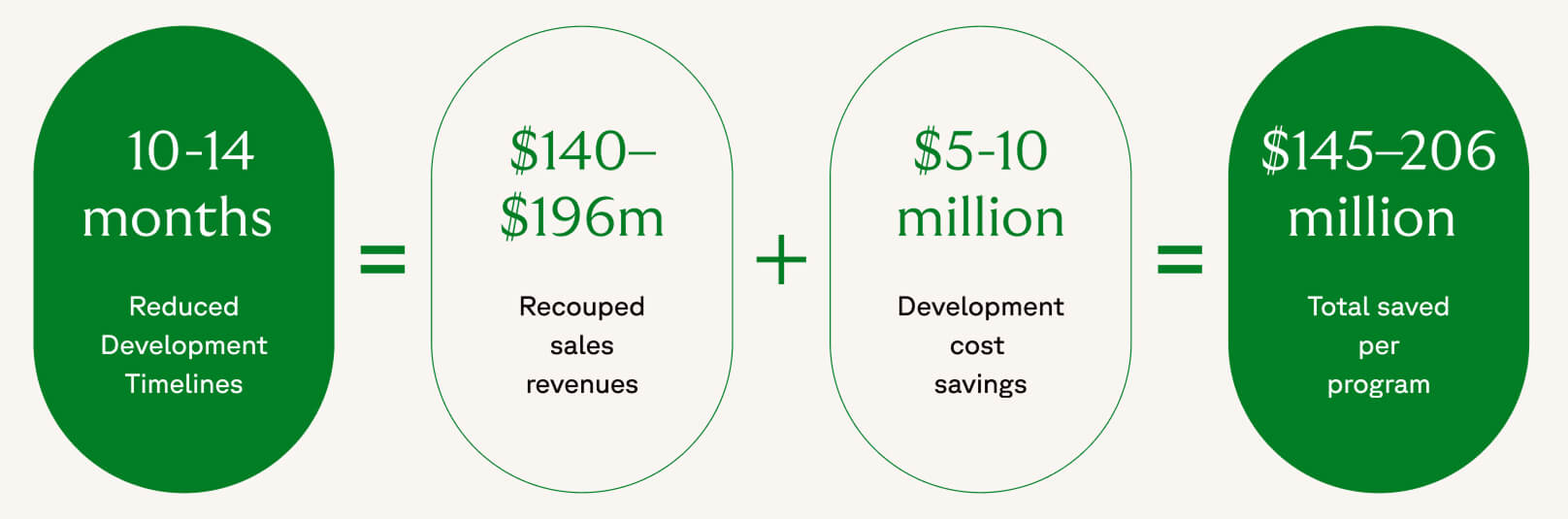
Model Informed Drug Development (MIDD) can reduce R&D cycle time by 10+ months per program, translating into $140-196 million in potential recouped sales revenue per asset.
Increased efficiency
MIDD enables smaller and fewer clinical trials by extrapolating data across populations and dosing regime, potentially saving $5 million per program and 10 months of development time.
Improved decision-making
MIDD supports go/no-go decision making, dose selection, and pipeline planning through drug efficacy and safety predictive insights. This helps avoid costly late-stage failures and improves the likelihood of regulatory and commercial success.
Pioneering Model Integrated Evidence
Model Informed Drug Development (MIDD) has established itself as a powerful methodology whereby mathematical and statistical models are employed to optimize drug development decision making and accelerate the R&D process. Adoption of this approach continues to expand, as do the technologies that empower it, with population modeling, physiologically-based pharmacokinetic modeling, clinical trial simulation and quantitative systems pharmacology to name a few. One of the key strengths of MIDD is it that allows decision-makers to explore in silico a myriad of therapeutic and trial design scenarios that would be prohibitively expensive to evaluate in the clinic. Developers then have the option of choosing whichever of these scenarios offers the best chance of success for their program.
Fortrea is pioneering the evolution of MIDD services into Model Integrated Evidence (MIE), which aims to generate regulatory-grade evidence that may replace or reduce the need for in-patient studies. This is set to revolutionize how clinical trials are conducted and significantly eliminate whitespace in pharmaceutical R&D.
The FDA has released multiple guidances supporting MIDD and runs a Paired Meeting Pilot Program to help sponsors integrate MIDD into their development plans. Now, regulatory bodies are increasingly accepting model-generated evidence as part of Clinical Trial Applications (CTAs) and Investigational New Drug (IND) submissions.


Enhanced patient outcomes
At Fortrea, Model Informed Drug Development (MIDD) strategies are transforming how therapies are tailored to individual patient needs. By simulating drug responses using advanced modelling techniques, MIDD can enable smarter dose selection and safer trial designs.
This approach is especially impactful for paediatric, geriatric, and rare disease populations, where traditional trial methods may fall short. MIDD helps reduce adverse events, improve efficacy, and support more precise labelling and clinical decision-making. As regulators increasingly accept model-generated evidence, Fortrea is helping sponsors bring better-targeted therapies to market faster—delivering meaningful improvements in real-world patient care.
How much could MIDD be worth to a development program?
(calculated on reasonable assumptions of costs)
Insights
Get the latest updates on Fortrea MIDD

Beyond Model Informed Drug Development: How Model Integrated Evidence is turning supportive analysis into primary evidence
Download Article
Unleashing the power of data sharing to transform the drug development landscape for kidney diseases
In 2016, Barbara Gillespie, MD, FASN, Vice President and Therapeutic Head of Nephrology at Fortrea, joined a workgroup with the Kidney Health Initiative (KHI) and U.S. FDA.
Download Article
Delivering timely data with a biomarker data management system
By designing and implementing customized processes for your biomarker data management system, we can help you power clear, confident decisions in your studies.
Download Case Study
Advanced therapies: The advantage of early and frequent regulatory interactions
Navigating the dynamic regulatory environment in cell and gene therapy development involves a complex and iterative process.
Read Advanced therapies: The advantage of early and frequent regulatory interactions
Promoting access to innovative cardiac medical devices through diversity and inclusion
Fortrea's efforts in promoting access to innovative cardiac medical devices, aiming to improve cardiovascular health through cutting-edge technology.
Read Promoting access to innovative cardiac medical devices through diversity and inclusionModel Integrated Evidence - related frequently asked questions
-
What is Model Informed Drug Development?
Model Informed Drug Development (MIDD) is an approach that uses quantitative models—such as pharmacokinetic/pharmacodynamic (PK/PD), exposure–response, and disease progression models—to integrate data from across preclinical and clinical development and inform key decisions on dose selection, study design, and benefit–risk assessment. By combining prior knowledge with emerging trial data, MIDD helps sponsors reduce uncertainty, optimize development pathways, improve the probability of technical and regulatory success, and, where appropriate, streamline development timelines while maintaining scientific and regulatory rigor.
-
What is Model Integrated Evidence?
Model Integrated Evidence (MIE) is an extension of Model Informed Drug Development in which validated, quantitative models are used not just to inform decisions, but to generate evidence that can supplement or, in some cases, replace clinical trial data in regulatory and development contexts. By treating model‑derived outputs—such as those from PK/PD, PBPK, exposure–response, or disease models—as decision‑grade evidence, MIE enables extrapolation to unstudied populations or scenarios, supports dose justification and comparative assessments, and helps address evidence gaps where traditional trials are impractical, thereby accelerating development and enabling more efficient, science‑based regulatory decision‑making.
-
What are the benefits of MIDD and MIE to drug developers?
MIDD improves decision‑making across the development lifecycle by using quantitative models (e.g., PK/PD, exposure–response, PBPK) to integrate data from preclinical, clinical, and external sources
The main benefits for drug developers are:
- Better dose selection and study design
- Smaller, fewer, and more efficient trials
- Earlier and more confident go/no-go decisions
- Improved regulatory interactions
MIE extends MIDD by treating model‑derived outputs as evidence, rather than solely as decision‑support tools. This delivers additional strategic advantages:
- Fills evidence gaps where trials are impractical or unethical
- Reduces the need for additional clinical studies in some contexts
- Accelerates development and lifecycle changes by augmenting or substituting clinical evidence
- Supports regulatory acceptance of alternative evidence