Ophthalmology
Personalized ophthalmic CRO services to advance your ocular therapies.
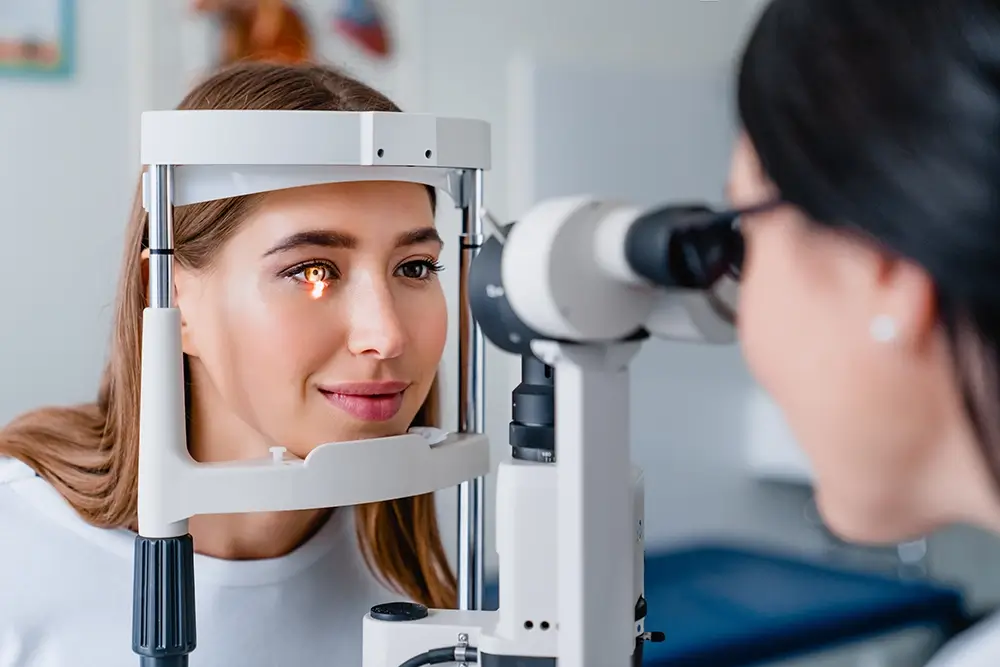
We’re advancing ground-breaking innovation with deep experience in front- and back-of-eye indications, ocular cell and gene therapies and specialized support in ophthalmology clinical trials.
Deep therapeutic experience
Our dedicated ophthalmology specialists with decades of proven experience deliver ophthalmology trials designed with patients in mind to accelerate your timelines and reduce development risk.
Data-driven site strategies
We provide data access and AI capabilities to deliver superior patient identification, monitor site performance, reduce administrative burden for sites and streamline participation for patients.
Agility at scale
You can rely on us to extend your team with global scalability to deliver everything from first-in-human to Phase III ophthalmology studies and post-marketing commitments.
Featured Insights
Ophthalmology Application Book, Volume 1
Explore how our team helps sponsors advance ocular therapeutics to address retinal disease, geographic atrophy, dry eye disease, progressive myopia and other vision-threatening conditions.
- Five high-impact case studies
- Practical solutions that maintain study momentum
- Thoughtful planning and responsive execution
- Deep therapeutic understanding to help sponsors navigate complexity
Applying AI to deliver impact across the ophthalmology trial lifecycle
Discover how AI is transforming ophthalmology clinical trials—from patient identification to data analysis, enhancing accuracy, speed and outcomes at each stage of the clinical trial journey. We share how Fortrea can support you in our White paper: How AI is reshaping ophthalmology trials at every stage.


Seasoned specialists for your study
The relationship between research staff and sites can make or break a study's success. That's why we created our Ophthalmology Academy, an internal training ground and cornerstone resource designed to help our personnel understand how to deliver comprehensive solutions and meet sites’ unique needs based on the intricacies of your ophthalmology trial.
Read the article: How our Ophthalmology Academy transforms clinical trials
Incorporating real-world data to find the right research sites
Through Verana Health’s collaboration with the American Academy of Ophthalmology’s IRIS® Registry, Fortrea has near real-time access to a set of curated, de-identified data and practice-level insights from the IRIS Registry to inform protocol design, enhance site selection and support patient recruitment strategies in ophthalmology clinical research.
Learn how Fortrea and Verana Health transform site selection together.


Streamlining the experience for sites and patients
As a CRO offering full-service ophthalmology support, our holistic approach starts with established site relationships to find the strongest, highest-performing ophthalmology sites for each study. We also provide a comprehensive, data-driven site and patient engagement strategy that incorporates best practices gleaned from our decades of ophthalmology trial experience to reduce site burden and increase patient retention.
Ophthalmology experience that matters
In the last 5 years, we have supported:

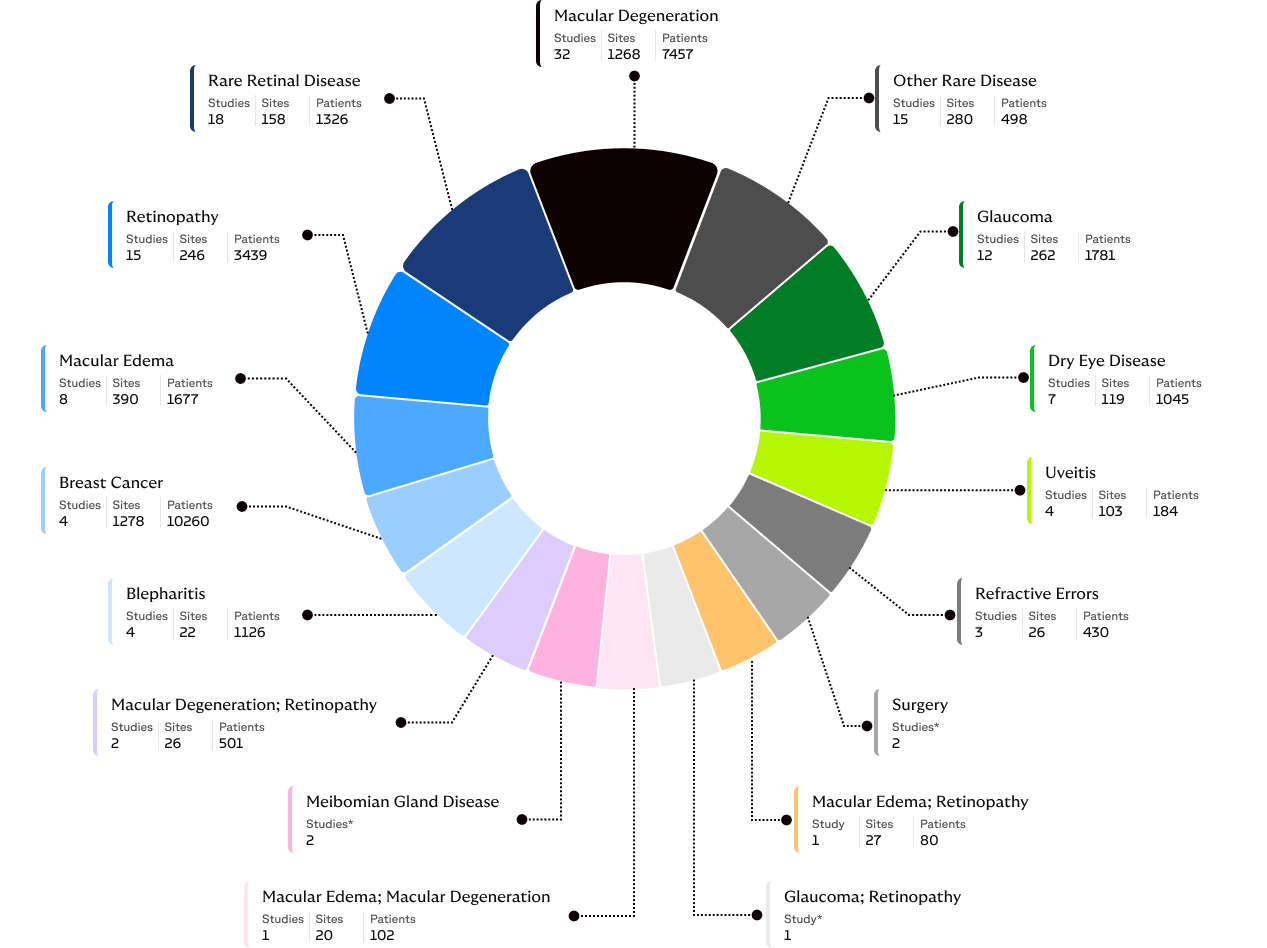
Ophthalmology areas of focus
We offer diverse experience in ophthalmology across multiple indications,in both front and back-of-the-eye indications, as well as in rare ocular diseases, cell and gene therapies, pediatrics and ophthalmic devices and diagnostics.
-
Posterior indications
Posterior indication trials in ophthalmology present a unique set of scientific, operational and regulatory challenges. Our experience spans:
- Macular degeneration
- Rare retinal diseases
- Retinopathy
- Uveitis
- Innovative therapies, including cell and gene treatments
-
Anterior indications
We deliver patient-centric solutions for anterior segment conditions through agile clinical trial design and our global site network. Our support has helped advance studies in:
- Dry eye
- Glaucoma
- Refractive errors
- Blepharitis
-
Inherited retinal disorders and rare ocular disease
We provide thoughtful strategies, deep therapeutic expertise and innovative approaches to advance clinical research in rare eye diseases, such as:
- Retinitis Pigmentosa
- Stargardt disease
- Batten disease
- Neuromyelitis optica spectrum disorder
Visit our Inherited retinal disorders and rare ocular disease
webpage -
Ocular cell and gene therapies
Advance your study in today’s ophthalmology cell and gene therapy market with support for our team. Our cell and gene therapy experience spans several indications, such as:
- Wet AMD
- Geographic atrophy
- Leber hereditary optic neuropathy
- Choroideremia
Our TEAM
Delivering ophthalmology leadership
An exceptional partnership starts with an experienced team. Browse the bios of our featured team members.

Tanya Richardson
Strategy Head, Ophthalmology and Neuroscience
Tanya has over 28 years of experience with Fortrea (formerly Labcorp, Covance and Chiltern), including monitoring, global project management, delivery director oversight and strategic planning and growth. Her clinical research experience includes a broad range of therapeutic experience with over 18 years in ophthalmology. Tanya’s ocular experience covers front and back of the eye indications, inherited retinal and ocular rare diseases across phase I-IV and medical device studies as well as ocular cell and gene therapies.
Her extensive delivery background, coupled with her ocular experience supports both internal and external stakeholders in the strategic development of a reduced burden approach, as well as an efficient and successfully executed ocular trial.
Tanya is passionate about ensuring the priorities of a clinical trial are 1) to reduce the burden across all stakeholders 2) a realistic, common-sense approach and 3) at the end of the day, we all do what we do for the patients.
Tanya is based in the US.
Laurentiu Gutiu, MD
Executive Medical Director - TA Lead Neuroscience and Ophthalmology
Dr. Gutiu is a board-certified neurologist with more than 15 years of clinical experience in a hospital setting across a wide range of neurological and psychiatric indications. He spent 10 years in academia as Assistant Professor of Neurology and attended doctoral courses in neuropharmacology. His 28 years of clinical research experience includes roles as an investigator, medical monitor and medical leadership positions spanning Phase I-IV studies.
He has broad range of experience across product modalities, including biologics and cell and gene therapies as well as medical expertise in neuro and psychiatric diseases, including, but not limited to, neurodegenerative, pain, neuromuscular and demyelinating.
Based in Germany.

David Hoelscher, MD
Senior Medical Director
Dr. Hoelscher has 26 years of CRO industry experience in a wide variety of therapeutic areas, most recently in the past 16 years focusing on medical monitoring in ophthalmology indications including: Retinal: dry/wet AMD, Non-infectious Uveitis, DME, Macular edema in uveitis, Vitreomacular traction, Proliferative/non-proliferative diabetic retinopathy. Anterior indications: dry eye, Glaucoma/POAG. Gene therapy: wet AMD, Batten’s disease. Rare disease: Batten’s disease, choroideremia, Stargardt’s disease, Retinitis Pigmentosa, Leber’s amaurosis.
While in medical school, he participated in Parkland Hospital’s “Mavericks in Ophthalmology” program, leading to a long fascination with research and the clinical practice of vision care.
Dr. Hoelscher is based in Austin, Texas.

Naidan Luo, MD, PhD
Senior Medical Director
Dr. Naidan Luo M.D Ph.D has over 28 years as a trained ophthalmologist and 23 years of clinical trial research experience in Phase I, II, III, IV in a wide variety of therapeutic areas, focusing on medical monitoring in ophthalmology indications including Glaucoma, Ocular hypertension, wet/dry AMD, Dry eye disease, Conjunctivitis, Blepharitis, Refractive error, Corneal Transplantation, NAION, LHON gene therapy, Stargardt disease, Ataxia, Parkinson Disease, AD, Woman health, COPD etc. Rare disease: Heriditary Spinocerebellar Ataxia (SCA), LHON.
Naidan is based in Beijing, China

Sarah Bolger-Ford, PhD
Senior Delivery Director, Strategic Delivery and Growth
Sarah Bolger-Ford is Senior Director within the Ophthalmology section of the Strategic Delivery and Growth group at Fortrea, based in the UK. She has a PhD in Physiology from King’s College London (UK) and has more than 26 years in the industry, from trainee CRA, through project management to her present position, and joined our company in November 2006.
She works with the pre-award team to provide client’s with tailored proposals, supports study teams in strategic delivery of awarded work and contributes to the growth of the ophthalmology portfolio.
Sarah is passionate about being part of the development of sight preserving and sight restoring solutions for patients.
Sarah is based in the UK.
Brian Guthrie, MBA
Delivery Director, Strategic Delivery & Growth
Brian has over 20 years clinical research experience, having worked at biotech companies, a global CRO and GlobalCare Clinical Trials. Brian joined Fortrea in 2020. He has hands-on experience in clinical operations, data management, medical writing, project management, portfolio management, line management, business development, contract execution, FDA/regulatory submissions and working with advisory boards. He has therapeutic experience in Ophthalmology, Neurology, Rare Disease, Oncology, Cardiovascular, Women’s Health and Trauma research and has spent the last 4 years dedicated to Ophthalmology.
Brian is passionate about patient centric clinical trials and finding creative solutions to reduce site and patient burden in a space filled with complex and debilitating disorders.
Brian is based in the US.

Richard Gambie
Senior Delivery Director, Ophthalmology & Neuroscience
Richard has more than 27 years of industry experience from Pre-Clinical work in the Pharmaceutical sector to Data Management, CRA & Project Management, in multiple therapeutic areas, focusing on Ophthalmology over the last 8 years, joining Fortrea in 2000. Richard provides delivery leadership to both his clients and project teams at portfolio & study level.
Richard prides himself in building strong relationships with sponsors and sites, recognizing how reducing patient burden and supporting site needs can make Fortrea the CRO of choice, in competitive landscapes, getting new products to market by delivering studies quickly and with quality.
Richard is based in the UK.
Diane Ostang
Delivery Director, Ophthalmology and Neuroscience
Diane Ostang, Delivery Director, has a background in Biomedical Engineering and brings over 22 years of industry experience across various therapeutic areas, with over 18 years as part of Fortrea team. She supports project teams at portfolio level, escalates priority issues, and ensures delivery oversight. Diane prides herself in building strong relationships with sponsors and sites, recognizing how reducing patient burden and supporting site needs can make our program the study of choice even in competitive landscapes.
Diane is based in US (ET).

Darby Thomas, PhD
Scientific Director, Cell & Gene Therapies
Darby Thomas, PhD, is the Scientific Director of Cell & Gene Therapies. She earned her PhD in Molecular Virology from Baylor College of Medicine, performed postdoctoral training at the University of Pennsylvania, followed by 17 years in industry prior to joining Fortrea (formerly Labcorp) in 2021.
Dr. Thomas has broad experience in adeno-associated virus (AAV) gene therapy with roles in CMC, discovery, translational development, and patient advocacy for several AAV-focused companies with an emphasis on rare neurological and metabolic diseases and ophthalmology. She also has translational experience developing plasmid-based gene therapies, lentiviruses, as well as gene-modified cell therapies for the treatment of rare skin disorders.
Dr. Thomas provides specialized scientific expertise providing leadership and guidance to integrated global teams, as well as internal and external consultation and training on cell and gene therapy programs.
Fortrea's pool of sites is rich. The PM and the CTLs are dedicated, have experience, performed well, and have good relationships with investigators and sites.
Large Pharma
We requested tight timelines. We needed this data cut in the timing we asked for to support our mission and I appreciated the can-do attitude that was shown. Fortrea came to the table with problem-solving in mind.
Senior vice president of Development Operations at Apellis
Insights
Get the latest updates from our ophthalmology team

Progressive myopia treatment evaluation in a multifocal contact lens trial
Download Case Study
Tapping LATAM's Untapped Patient Pool for Ophthalmology Trials
Watch Tapping LATAM's Untapped Patient Pool for Ophthalmology Trials
Innovative ocular solutions: Improving lives through advanced therapies
Download Info Sheet
Ophthalmology gene therapy trial: Insights from a Senior Clinical Project Manager
At Fortrea, we recognize that the deep knowledge and leadership of our diversity teams are fundamental to driving innovation and delivering results for our sponsors
Download Case Study
Ophthalmology Gene Therapy Trial: Insights from a Senior Clinical Project Manager
Read Ophthalmology Gene Therapy Trial: Insights from a Senior Clinical Project Manager
Stay ahead of the curve: How AI is reshaping ophthalmology trials at every stage
How can AI in ophthalmology transform each critical stage of your trial journey?
Download White Paper
Navigating recruitment complexity and regional nuances in a Phase III Global Geographic Atrophy trial
Download Case Study
Seeing the future: How Fortrea is shaping the next chapter in ophthalmology trials
Read Seeing the future: How Fortrea is shaping the next chapter in ophthalmology trials

Choosing the right AI vendor for clinical trials in a rapidly evolving landscape
Choosing the right AI vendor can transform your clinical trial strategy. Explore key questions to shape effective, future-ready collaborations.
Read Choosing the right AI vendor for clinical trials in a rapidly evolving landscape
AI can find the patients-but can humans reach them?
If AI can rapidly identify eligible patients for ophthalmology clinical trials, what strategies must sponsors, CROs and research sites adopt to overcome human and operational barriers and full realize AI's potential in patient recruitment?
Download Article
How can AI in ophthalmology transform each critical stage of your trial journey?
How can AI in ophthalmology transform each critical stage of your trial journey?
Download White Paper
Unlocking biotech potential: Delivering expedited data management
How can a close sponsor-CRO collaboartion meet a newly requested critical milestone?
Download Case Study
Considerations for clinical trials of dry eye syndrome in a crowded landscape
How do you design Dry Eye Syndrome studies that are both scientifically rigorous and operationally feasible with the challenges of complexity, high placebo response rates, subjective symptoms, environmental variability and a competitive landscape?
Download White Paper
Designing smarter dry eye trials with patients at the center - real world experiences shared
Discover real-world strategies for designing smarter, faster dry eye syndrome (DES) trials. Insights from Fortrea’s latest hands-on clinical experience
Read Designing smarter dry eye trials with patients at the center - real world experiences shared
Revolutionizing ophthalmology trials: How Fortrea and Verana Health transform site selection together
In the increasingly crowded landscape of ophthalmology clinical trials, finding the right research sites has become a significant challenge.
Read Revolutionizing ophthalmology trials: How Fortrea and Verana Health transform site selection together
Addressing the implications for long-term follow-up in discontinued gene therapy studies
Download White Paper
Raising the bar: How our Ophthalmology Academy transforms clinical trials
Read Raising the bar: How our Ophthalmology Academy transforms clinical trials
Collaborative practices advance an ultra-rare ophthalmological disease clinical trial
Fortrea forged strong connections with sites and an advocacy group to create a high level of participant interest in a rare disease clinical trial. Learn how the team applied its ophthalmological, rare disease and operational expertise to ultimately surpass recruitment targets by more than ~20% of the sponsor’s original target—and help the sponsor achieve an orphan drug designation for their treatment.
Download Case Study
Ophthalmology medical device development: Innovative advances in vision care
Discover Fortrea's innovative advances in ophthalmology medical device development, enhancing eye disease treatments.
Read Ophthalmology medical device development: Innovative advances in vision careOphthalmology Frequently Asked Questions
Driving innovation in clinical trials
-
What are the research trends in ophthalmology?
Research trends in ophthalmology are increasingly focused on advanced therapeutics for retinal and degenerative eye diseases, including innovations in gene therapy, biologics and sustained-release drug delivery systems. Significant attention is being directed toward treatments for conditions such as Age-related macular degeneration, diabetic retinopathy, glaucoma and dry eye disease. Sponsors are also investing in precision medicine approaches, AI-driven imaging analytics and novel endpoints that improve trial efficiency and regulatory success. For drug development sponsors, these trends signal a growing demand for specialized clinical research infrastructure, biomarker validation and global patient recruitment strategies in ophthalmology trials.
-
What is the new technology for ophthalmology?
New technology in ophthalmology is transforming both clinical care and drug development, particularly through AI-powered diagnostic platforms, digital biomarkers and advanced imaging systems such as optical coherence tomography. Innovations in sustained-release implants, gene editing techniques and minimally invasive surgical devices are accelerating therapeutic pipelines. Additionally, decentralized clinical trial tools and remote visual acuity assessments are improving patient access and retention. For sponsors, integrating these technologies into ophthalmology clinical trials enhances data precision, shortens development timelines and supports regulatory-grade evidence generation.
-
What is the role of CRO in ophthalmology clinical trials?
A contract research organization (CRO) plays a critical role in the successful execution of ophthalmology clinical trials by providing therapeutic experience, regulatory strategy, site selection, patient recruitment and endpoint management. Given the complexity of ophthalmic endpoints—such as visual acuity, intraocular pressure and retinal imaging—a specialized CRO facilitates protocol optimization and high-quality data collection. From early-phase first-in-human studies to global Phase III programs, post approval and natural history studies, CROs like Fortrea help sponsors navigate regulatory requirements, manage safety monitoring and accelerate time to market for novel ophthalmic drugs, biologics and devices.
-
What is the most common diagnosis in ophthalmology?
One of the most common diagnoses in ophthalmology is cataract, a condition characterized by clouding of the eye’s natural lens and a leading cause of vision impairment worldwide. Other highly prevalent conditions include refractive error, glaucoma and age-related macular degeneration. For drug development sponsors, the high global disease burden across these indications underscores significant opportunities for innovative therapeutics, combination therapies and long-acting formulations within ophthalmology clinical research.