
How ctDNA Is Reshaping Precision Oncology



Precision oncology is reshaping how oncology trials are designed and delivered. Biomarker defined populations are being incorporated earlier in development and are becoming smaller and more complex, increasing operational demands across each stage of a study.
In the recently concluded Fortrea’s webinar on Precision Oncology in Practice , Khaled Tolba, MD, sets the stage by explaining how circulating tumor DNA (ctDNA) is transforming how sponsors think about risk stratification, trial design, and decision making in early stage cancer.
For sponsors developing therapies in adjuvant or curative intent settings, ctDNA is evolving beyond an exploratory biomarker and is increasingly being considered as a strategic tool to inform development decisions and clinical insight.
What Is ctDNA—and Why Sponsors Should Care
ctDNA consists of small fragments of tumor derived DNA released into the bloodstream. As Dr. Tolba explains, these fragments can persist after surgery or definitive therapy, signaling the presence of minimal residual disease (MRD). Detecting this signal can allow sponsors to identify patients at higher risk of relapse— sometimes before recurrence becomes clinically visible.1
From a sponsor perspective, this capability changes the development equation:
- Earlier risk identification
- More targeted patient populations
- Clearer biological signals of treatment effect
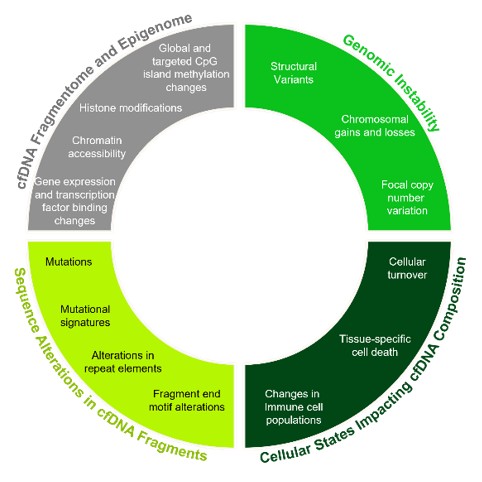
The Landscape of Alterations Detectable in cfDNA
Tumor Informed Testing and the Shift Toward Greater Sensitivity
A central theme of Dr. Tolba’s presentation is the distinction between tumor agnostic and tumor informed ctDNA approaches.
- Tumor agnostic assays screen for common mutations across cancers.
- Tumor informed assays are customized to each patient, tracking mutations identified in the original tumor tissue.
Because tumor informed assays search for a known molecular “fingerprint,” are generally associated with greater sensitivity—making them particularly valuable in MRD detection where ctDNA levels are extremely low. As a result, tumor informed approaches are increasingly considered as the preferred strategy for MRD assessment in early stage disease
The Role of ctDNA in Early-Stage Disease
Dr. Tolba underscores that ctDNA is especially impactful in early stage cancers, where treatment decisions are often made with incomplete information. In diseases such as non small cell lung cancer, detectable ctDNA after surgery or chemoradiation strongly correlates with future relapse, while ctDNA negative patients may experience significantly better outcomes.2
For sponsors, this opens several strategic opportunities:
- Trial enrichment by enrolling MRD-positive patients most likely to benefit.
- Smaller, faster studies with earlier event accumulation.
- Exploratory endpoints such as ctDNA clearance to support mechanism-of-action narratives.
Technology Options and Practical Considerations
The presentation also addresses the practical realities of ctDNA implementation. Detecting tumor DNA at very low allele fractions presents technical challenges, and results can be influenced by factors such as:
- Pre-analytical variability in sample collection and handling
- Assay sensitivity limits
- Interference from clonal hematopoiesis
- Differences in interpretation and reporting standards
What This Means for Sponsors
ctDNA is increasingly moving beyond a research tool and is being explored as a means to inform development strategies. Sponsors who integrate ctDNA thoughtfully can:
- Improve patient selection and trial efficiency
- Strengthen biological proof points
- Lay the groundwork for future precision medicine indications
With experienced collaborators and well designed workflows, ctDNA driven strategies are being implemented today as part of evolving oncology approaches.
Want to Go Deeper?
The full webinar explores regulatory considerations, real world colorectal cancer data, and operational execution in greater detail. To access the complete transcript or discuss how ctDNA could support your next oncology program, connect with Fortrea’s oncology team.
Disclaimer:
This content is intended for general informational purposes only and does not constitute regulatory, scientific, or legal advice. The perspectives reflect the speaker’s views and do not represent formal regulatory guidance or guaranteed outcomes. Regulatory requirements may vary by study jurisdiction, context and design.
References:
- Circulating tumour DNA-Based molecular residual disease detection in resectable cancers: a systematic review and meta-analysis - eBioMedicine
- Medical Device Coordination Group document - https://health.ec.europa.eu/document/download/12f9756a-1e0d-4aed-9783-d948553f1705_en