
Moving Beyond the Podium: What ASCO 2026 Means for the Reality of Trial Execution


The curtain has closed on the ASCO 2026 Annual Meeting. While the plenary sessions rightly celebrated groundbreaking survival curves and the fall of historically "undruggable" targets8, clinical trial sponsors came away with a sobering realization: the sophistication of oncology science is officially outpacing the traditional infrastructure built to execute it.
For biopharma sponsors, the true takeaway from ASCO 2026 isn't just the data on the slides—it’s the looming execution bottleneck. To successfully bring the next generation of oncology assets to market, the industry must pivot from standard site management toward a model of Smarter Delivery.
Here is an operational look at the major shifts from ASCO 2026 and how sponsors can navigate them to ensure trial success.
1. The "Undruggable" is Falling—But Patient Pools Are Shrinking
ASCO 2026 proved that precision medicine is conquering the toughest targets. We saw standing ovations for RAS(ON) inhibitors in pancreatic cancer and FGFR2-targeted therapies in advanced cholangiocarcinoma1, 2. Simultaneously, genomic profiling is moving upstream, not just to select treatments, but to help specific patient populations safely avoid toxic chemotherapies3.
The Operational Challenge
As targeting becomes more precise, eligibility criteria narrow. When you are looking for a highly specific, rare genetic mutation, standard "high-volume academic center" recruitment strategies fail. You end up competing for the same biomarker-eligible patient at a small number of high-volume academic centres — the same institutions anchoring multiple programmes simultaneously.
The Smarter Delivery Pivot
Sponsors must abandon passive recruitment. Success now requires predictive, data-driven site matching.
- Go Beyond Volume: Select sites based on historical genetic screening velocities and real-time biomarker testing patterns, rather than general oncology patient counts.
- Activate Community Networks: Move trials closer to where the patients actually are by equipping high-performing community oncology networks with decentralized operational support.
2. Platform Modalities Dominate (ADCs & Bispecifics)
The competitive landscape has shifted definitively from single small molecules to complex platform technologies. The data presented on antibody-drug conjugates (ADCs) and bispecific antibodies in first-line non-small cell lung cancer (NSCLC) showcased unprecedented efficacy4, 5. Meanwhile, cell therapy is rapidly trying to solve its scale problem, with early in vivo CAR-T data promising to bypass complex ex vivo manufacturing entirely6.
The Operational Challenge
These advanced modalities introduce highly complex, overlapping toxicity profiles (such as ADC-related interstitial lung disease or unique cytokine release patterns in bispecifics, CAR-Ts and TCRs). Furthermore, managing the logistical supply chain for platform therapies requires absolute operational precision.
The Smarter Delivery Pivot
Sponsors cannot hand these protocols over to generalist operational teams.
- Embedded Scientific Oversight: Ensure your project teams are led by dedicated, oncology-specific medical monitors who understand the cellular mechanism of action intimately.
- Proactive Safety Frameworks: Build specialized safety and data-monitoring workflows into the protocol from day one to catch and manage complex adverse events before they impact patient retention.
3. The Multimodal Frontier: AI, Real-World Data and GLP-1 Research Drive New Oncology Insights
One of the most discussed data points at ASCO 2026 came from the intersection of metabolic health and oncology, where real-world data linked GLP-1 receptor agonists to reduced metastatic progression in obesity-related cancers7. Parallel to this, artificial intelligence has matured from a buzzword into a multimodal tool—combining clinical records, pathology, and genomics to optimize test-to-treatment pipelines.
The Operational Challenge
Oncology trials can no longer look at tumor biology in a vacuum. A patient's broader metabolic health, background medications, and real-world health data are actively influencing trial outcomes and data cleanliness.
The Smarter Delivery Pivot
Sponsors need to integrate advanced data capabilities directly into their clinical strategy.
- Account for Background Variables: Proactively design protocols to track and adjust for confounding metabolic variables.
- Leverage Multimodal Data: Use real-world data and AI integration to identify hidden patient populations who are missing out on molecular testing, accelerating your study's time-to-market.
4. Patient-Centricity Moves Upstream: PROs from Day One
A notable signal from ASCO 2026 was the dedicated focus on quality of life (QOL) and patient-reported outcomes (PROs), with multiple sessions and data presentations highlighting their growing importance in clinical development.
The Operational Challenge
Historically, PROs have been treated as secondary or exploratory endpoints, typically introduced in later-phase trials. As these measures move earlier—potentially into Phase 1 studies—trial designs must account for additional data collection, patient burden, and real-time interpretation of subjective outcomes alongside traditional safety and efficacy endpoints.
The Smarter Delivery Pivot
Sponsors must embed patient-centric measurement into protocol design from the outset.
- Design for the Patient Voice Early: Integrate validated PRO instruments in early-phase trials to capture tolerability and real-world impact alongside dose-finding.
- Reduce Site and Patient Burden: Use digital tools and decentralized approaches to collect PRO data seamlessly without overcomplicating site workflows.
- Translate Insights into Action: Ensure PRO data is not just collected but actively used to inform dose optimization, safety management, and patient retention strategies.
The Bottom Line: Engineering the Science of the Trial
If ASCO 2026 taught us anything, it’s that a great protocol is only as good as its execution strategy. To truly deliver value to patients and stakeholders, we must move away from text-heavy, cliché motivational messaging for sites and patients.
True patient-centricity means translating complex, advanced cellular science into clean, highly visual, and intuitive operational workflows. When investigators, site staff, and patients seamlessly understand the why behind the protocol, recruitment accelerates, data quality improves, and timelines are met.
Let’s build the future of trial execution together. How is your team adapting its operational strategy to handle the post-ASCO 2026 landscape? Let's connect to discuss how a science-first approach can accelerate your asset's development.
References
- American Society of Clinical Oncology (ASCO) 2026 Annual Meeting. Abstract #302: Phase 3 'RASolute' study of daraxonrasib in KRAS-mutated pancreatic cancer.
- ASCO 2026 Annual Meeting. FIGHT-302: Pemigatinib vs. standard chemotherapy in FGFR2-positive advanced cholangiocarcinoma.
- ASCO 2026 Annual Meeting. OPTIMA Trial: Genomic profiling to guide omission of chemotherapy in hormone receptor-positive breast cancer.
- ASCO 2026 Annual Meeting. Evaluation of sacituzumab tirumotecan (sac-TMT) combined with pembrolizumab in first-line non-small cell lung cancer (NSCLC).
- ASCO 2026 Annual Meeting. HARMONi-6 Phase 3 Trial: Ivonescimab versus PD-1 inhibitor combinations in advanced squamous NSCLC.
- ASCO 2026 Annual Meeting. Emerging data and scalability of in vivo CAR-T cell therapies (KLN-1010 platform updates).
- ASCO 2026 Annual Meeting. Real-world analysis of GLP-1 receptor agonist exposure and metastatic risk reduction across obesity-related malignancies.
- https://www.sciencedaily.com/releases/2026/06/260604044247.htm
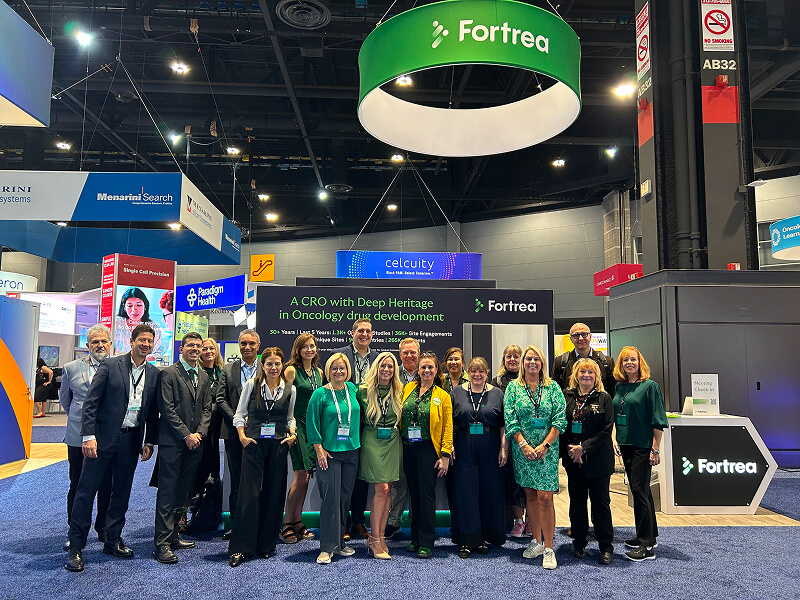
Proudly Showcasing Our Contributions to ASCO 2026
ASCO 2026 | Poster
Real-world effectiveness of MET inhibitors versus immunotherapy ± chemotherapy in 1L for patients with MET exon 14 skipping mutations in non-small cell lung cancer.
Authors: Kamal S. Saini, Maria Ignacia Berraondo, Paulo Ricardo Santos Nunes Filho, Carolina Dutra, Luca Cantini
ASCO 2026 | Abstract
Treatment Strategies in Metastatic NSCLC after progression to Immuno-chemotherapy: A Random Effects Network Meta Analysis of Phase III Trials.
Authors: Luca Cantini, Kamal S. Saini, Maria Garcia Requesens

Fortrea is proud to partner with #GildasClubChicago to create and distribute care packages at cancer centers across the Chicagoland area.
Stop by booth 13141 at #ASCO26 to virtually build and personalize a care package for a pediatric, teen, or adult patient!
Learn more about how Gilda’s Club is supporting the Chicago community: https://www.gildasclubchicago.org/
- Ascension Saint Mary Chicago
- Ann & Robert H. Lurie Children’s Hospital
- Ascension Saint Joseph - Chicago
- Robert H. Lurie Comprehensive Cancer Center of Northwestern University
- Advocate Children’s Hospital
- Advocate Christ Medical Center and the Gilda's Club Chicago satellite clubhouse at Advocate Christ Medical Center
- Gilda's Club Chicago Downtown Clubhouse
ASCO 2025 Highlights: Key Insights in Oncology
Explore key takeaways from ASCO 2025, including emerging trends, innovative therapies, and insights shaping the future of oncology clinical trials.

More from our Oncology Insights

Precision medicine in 2026: What it means for complex disease development
Read Precision medicine in 2026: What it means for complex disease development
Clinical Development in the Precision Medicine Era
Precision medicine is transforming oncology trials by targeting genetic profiles. Discover how sponsors can adapt trial designs and strategies to stay ahead.
Read Clinical Development in the Precision Medicine Era