
New Approach Methodologies (NAMs): From emerging science to regulatory reality


New Approach Methodologies (NAMs) are increasingly becoming part of mainstream regulatory thinking for drug development as agencies seek to reduce reliance on animal testing with more human-relevant approaches. Recent developments from both the U.S. Food and Drug Administration (FDA) and the European Medicines Agency (EMA) suggest that the conversation has shifted from whether NAMs can be used to how and where they can be applied effectively.
What are new approach methodologies?
The Food and Drug Omnibus Reform Act of 2022 amended the Federal Food, Drug, and Cosmetic Act (the statute that grants the FDA its regulatory authority) and defined ‘nonclinical test’ as “a test conducted in vitro, in silico, or in chemico, or a nonhuman in vivo test, that occurs before or during the clinical trial phase of the investigation of the safety and effectiveness of a drug.”1
Intended to complement or replace animal studies & provide mechanistic and human-relevant insights
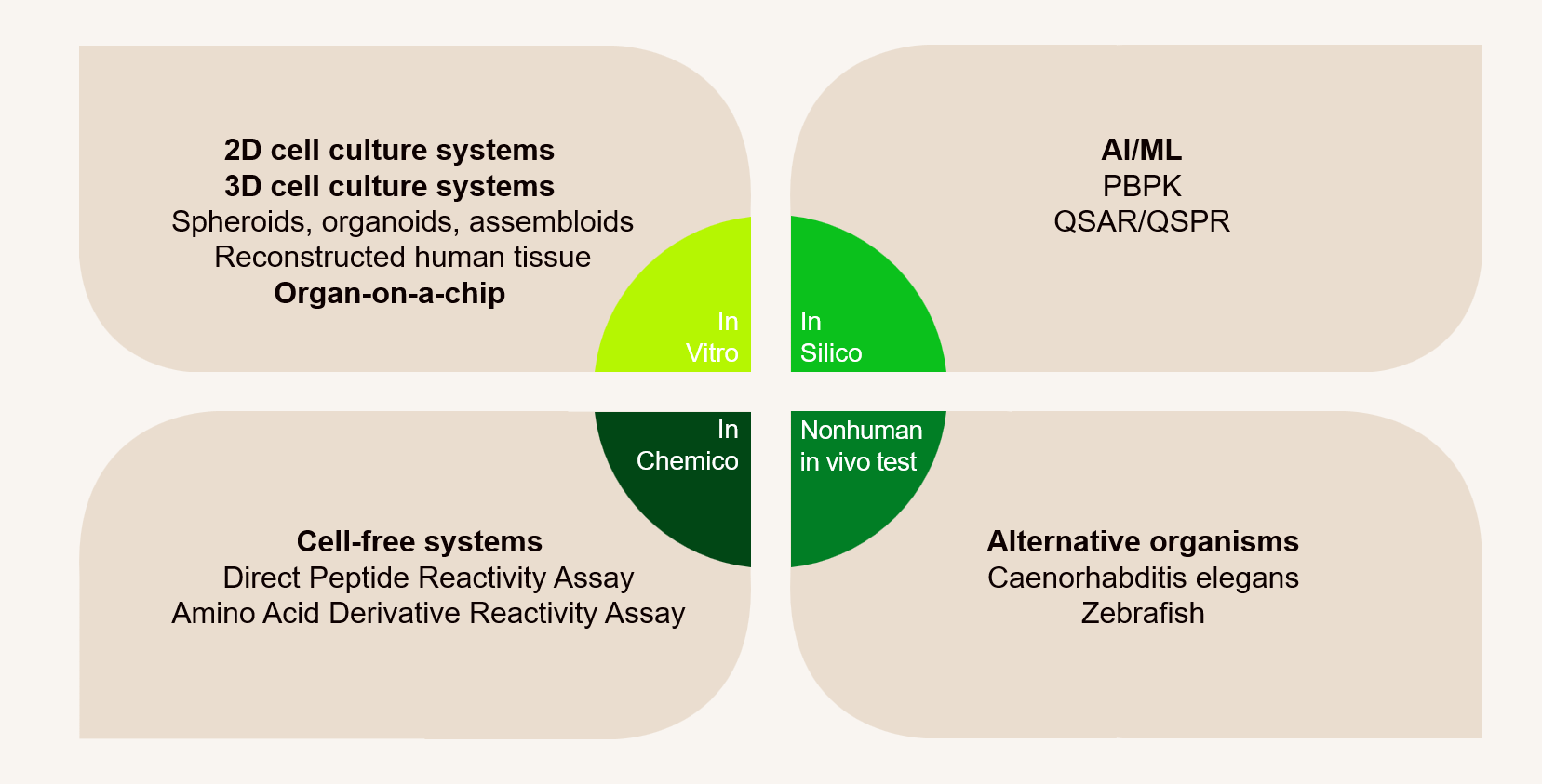
The common goal of these techniques is to complement or, where scientifically justified, replace traditional animal studies while providing mechanistic and human-relevant insights.
Building momentum across the regulatory landscape
The regulatory landscape for NAMs has evolved considerably over the last two decades, reflecting a growing commitment to reducing reliance on animal testing while improving the relevance of nonclinical data to human biology. Key milestones include the European Union's restrictions on animal testing of cosmetics, introduced in 2004, the EMA's 2016 guideline2 on regulatory acceptance of 3Rs approaches (Replacement, Reduction, and Refinement), and the passage of the U.S. FDA Modernization Act 2.0 in 2022, which removed the statutory requirement for animal testing in preclinical drug development.
Momentum has continued to build in recent years. The U.S. National Institutes of Health (NIH) recently announced a move away from funding animal-only research, placing greater relevance on human-relevant approaches, including NAMs3. The FDA has further strengthened this direction through the publication of a strategic roadmap in 20254 and draft guidance in 20265, both of which support the integration of NAMs into drug development and regulatory decision-making. Similarly, the EMA has highlighted opportunities to incorporate NAMs into regulatory assessments, while the UK Government has announced plans to accelerate the reduction of animal testing across the life sciences sector6.
Technological innovation is helping to drive this transition. Advances in induced pluripotent stem cell (iPSC) technologies, organoid models, automation, high-throughput screening platforms, and artificial intelligence-enabled data analytics are supporting the continued development and application of NAMs4. As a result, developers are increasingly able to generate mechanistic, human-relevant data that can provide deeper insights into safety, efficacy, and disease biology, often beyond those achievable with traditional animal models.
Together, these regulatory and scientific advances are creating new opportunities to modernise nonclinical development, improve the predictive value of preclinical data, and support more efficient drug development pathways.
What are the promise of new approach methodologies?
One of the strongest arguments for NAM adoption is enhanced human relevance. Species differences in traditional animal models can limit their ability to predict human outcomes, particularly for biologics, CGTs and human-specific targets where animal models may have limited translatability. NAMs offer the opportunity to study human biology directly, potentially improving prediction of toxicity. For certain applications and endpoints, human-based NAMs have demonstrated the potential to provide information that is more relevant to human outcomes than traditional animal models5,7.
Additional advantages include faster timelines, reduced costs, greater mechanistic understanding of toxicity pathways, and support for the 3Rs (Replacement, Reduction and Refinement). Importantly, NAMs are integrated into a weight-of-evidence framework, combining multiple complementary data sources to support decision-making.
Challenges to regulatory acceptance of NAMs remain
Despite growing enthusiasm, significant challenges remain. Many NAMs are still under development and do not fully replicate the complexity of whole-organism physiology. Regulatory acceptance remains largely case-specific, and greater global harmonisation of validation frameworks and evidentiary standards is needed. Furthermore, technological innovation often advances more rapidly than regulatory frameworks, creating uncertainty for sponsors seeking to incorporate novel approaches into development programmes.
For regulators, establishing confidence in a NAM remains critical. The FDA has identified several key considerations, including a clearly defined context of use (COU), demonstration of human biological relevance, robust technical characterisation, and evidence that the methodology is fit for purpose.5 Importantly, regulatory acceptance is not necessarily dependent on universal validation of a methodology across all potential applications. Rather, acceptance is typically based on the intended context of use and the totality of evidence demonstrating that the NAM can reliably inform a specific regulatory question or development decision. As a result, a NAM may be considered acceptable for one application while requiring additional qualification, validation, or supporting data for another.
Where are NAMs making the most progress?
Regulatory progress is uneven across safety assessment endpoints. Some areas already have well-established NAM solutions. Skin irritation and corrosion testing can utilize reconstructed human epidermis models, while eye irritation assessments may employ human cornea-like tissues and other non-animal approaches. Skin sensitization testing has evolved from guinea pig assays toward integrated in chemico and in vitro approaches supported by OECD test guidelines.8
For pharmacokinetic assessments and genotoxicity testing a mixture of in vitro and in vivo assessments are currently used. Organ-on-a-chip systems and omics technologies also contribute to early screening for systemic toxicity. However, pivotal (repeated dose) toxicity, carcinogenicity, and developmental neurotoxicity remain areas where NAM development has not yet achieves broad regulatory acceptance as complete replacements for traditional in vivo studies4,5.
Test Endpoint - Available/Emerging NAMs
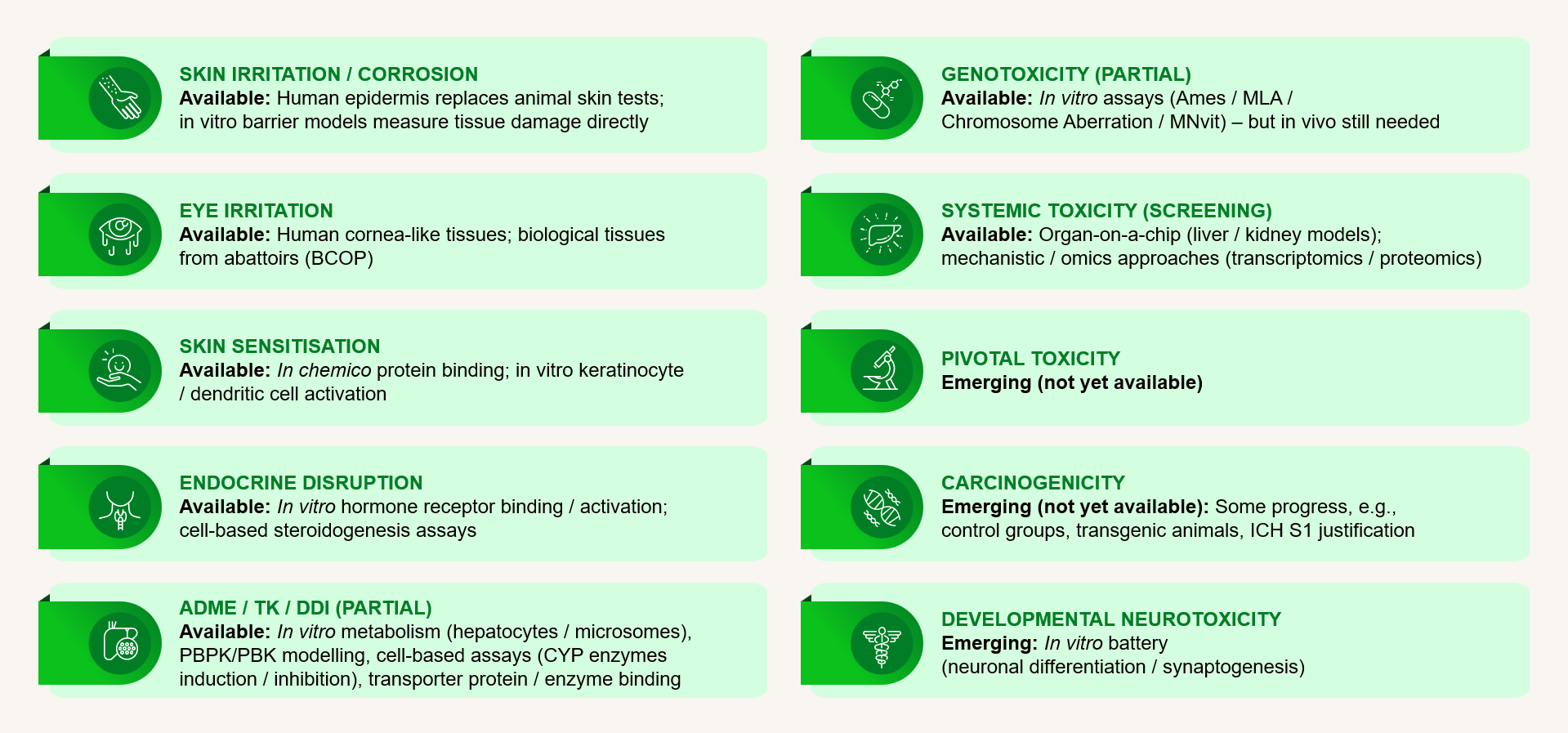
Figure adapted from FDA Roadmap to Reducing Animal Testing in Preclinical Safety Studies (2025), FDA Draft Guidance on General Considerations for the Use of New Approach Methodologies in Drug Development (2026), and OECD Guideline No. 497 (2026)
The next frontier: Virtual control groups
One of the most notable recent developments is the EMA's draft qualification opinion on virtual control groups.9 This approach would use historical control data combined with statistical matching and expert judgment to replace concurrent controls in specific rat non-GLP dose-range finding studies. Although the proposed use is limited and not currently intended for pivotal toxicology studies or regulatory safety decisions, virtual controls represent an important regulatory precedent for a NAM in toxicology. The initiative highlights how regulators are beginning to embrace innovative approaches when supported by strong scientific evidence and clearly defined operating procedures.
Looking ahead to the future of new approach methodologies
The future of NAMs is likely an evolution rather than revolution. Regulatory agencies appear aligned on maintaining key safety and efficacy endpoints required for drug development while allowing underlying data generation methods to change. As NAM technologies mature and validation frameworks strengthen, their role in regulatory submissions will continue to expand.
Ultimately, the most successful developers will not view NAMs simply as replacements for animal studies. Instead, they will see them as part of an integrated evidence-generation strategy that combines human relevance, mechanistic insight, computational power, and regulatory science. The question is no longer whether NAMs have a place in drug development, but how quickly stakeholders can realize their full potential.
How Fortrea can support your regulatory needs
While regulatory acceptance of NAMs is advancing rapidly, important differences remain in how individual regulatory agencies evaluate and apply these approaches. As a result, sponsors should carefully consider the evolving regulatory landscape when defining their nonclinical and clinical development strategies. It is also important not to assume that suitable, validated NAMs are readily available to replace all animal studies, as applicability and regulatory acceptance can vary depending on the product, indication, and development stage.
A well-defined nonclinical strategy that effectively de-risks the development program and is aligned with regulatory expectations is a critical foundation for successful clinical development. Early engagement with health authorities can help sponsors gain clarity on the appropriateness of proposed approaches and reduce the risk of delays later in development.
Fortrea's Regulatory Consulting team collaborates with sponsors to understand their product-specific development objectives, evaluate the available scientific evidence, and define a tailored regulatory engagement strategy to obtain meaningful agency feedback. By taking this proactive approach early in development, sponsors can improve program efficiency, minimize rework, reduce regulatory uncertainty, and ultimately accelerate development timelines.
Request a call with the Fortrea Regulatory Consulting team to discuss the opportunities that new approach methodologies could offer your business.
References
- Section 3209 (Animal Testing Alternatives) of the Food and Drug Omnibus Reform Act of 2022 enacted as part of the Consolidated Appropriations Act, 2023. Consolidated Appropriations Act, 2023, Pub. L. No. 117-328, 136 Stat. 4459 (2022). https://www.govinfo.gov/content/pkg/PLAW-117publ328/pdf/PLAW-117publ328.pdf
- EMA (2016) Guideline on the principles of regulatory acceptance of 3Rs (replacement, reduction, refinement) testing approaches. 15 December 2016 EMA/CHMP/CVMP/JEG-3Rs/450091/2012 (CHMP & CVMP). https://www.ema.europa.eu/en/documents/scientific-guideline/guideline-principles-regulatory-acceptance-3rs-replacement-reduction-refinement-testing-approaches_en.pdf
- National Institutes of Health (2025) NIH to prioritize human-based research technologies. Published 29 April 2025. https://www.nih.gov/news-events/news-releases/nih-prioritize-human-based-research-technologies
- FDA (2025) Roadmap to Reducing Animal Testing in Preclinical Safety Studies. https://www.fda.gov/files/newsroom/published/roadmap_to_reducing_animal_testing_in_preclinical_safety_studies.pdf
- FDA (2026) General Considerations for the Use of New Approach Methodologies in Drug Development (draft) https://www.fda.gov/regulatory-information/search-fda-guidance-documents/general-considerations-use-new-approach-methodologies-drug-development
- UK Government (2024) Accelerating the uptake of alternatives to animal testing. Department for Science, Innovation and Technology. Published 17 May 2024. Available at: https://www.gov.uk/government/publications/accelerating-the-uptake-of-alternatives-to-animal-testing/accelerating-the-uptake-of-alternatives-to-animal-testing
- Ewart L, Dehne EM, Fabre K, et al. Application of microphysiological systems to enhance safety assessment in drug discovery. Annu Rev Pharmacol Toxicol. 2022;62:547-569
- OECD (2026) Guideline No. 497: Defined Approaches on Skin Sensitisation. Adopted 2 July 2026. https://www.oecd.org/content/dam/oecd/en/publications/reports/2023/07/guideline-no-497-defined-approaches-on-skin-sensitisation_30b1718f/b92879a4-en.pdf
- EMA (2026) Draft Qualification opinion for Virtual Control Groups (VCG) to replace Concurrent Control Groups (CCG) in rat non-GLP Dose-Range Finding (DRF) studies. 31 March 2026 EMADOC-1700519818-3025927 CHMP. https://www.ema.europa.eu/en/news/ema-consults-virtual-control-groups-help-reduce-animal-use-medicines-development