Posterior Indications
Advance your ophthalmology study with confidence.

Generate reliable and meaningful trial outcomes for your ophthalmology clinical trial with a team that understands the unique complexities of ocular disease development.
Comprehensive, agile support
We help posterior ocular trials navigate challenges like complex imaging, variable disease progression and patient retention to accelerate the path ahead.
Data integrity
Our ophthalmology imaging specialists handle complex assessments and procedures with established vendors to promote consistent, high-quality data across multiple sites and generate more reliable and meaningful trial outcomes.
Deep clinical experience
We apply our experience in medical devices, diagnostics, rare disease trials and gene therapies to transform ophthalmology development challenges into competitive advantages.
Manage scientific complexity in posterior segment trials
In posterior ocular trials of macular degeneration, rare retinal diseases, retinopathy or uveitis, patient responses can vary by age and disease stage and include differences in inflammatory and pigmentary changes. We apply our scientific, operational and regulatory experience to help sponsors navigate these inherent complexities with confidence.


Address monitoring and operational challenges
Subtle intraocular changes, imaging consistency and long-term follow-up make trial execution complex in posterior indication ophthalmology trials. We leverage our strategic AI collaborations and established imaging specialist networks along with experience medical monitors to help maintain data quality and patient safety in your study.
A focus on posterior indications
Macular degeneration
Macular degeneration clinical trials commonly face slow disease progression, variability in patient responses and the need for precise retinal imaging and long-term monitoring. We support these trials by designing robust protocols, standardizing imaging and assessments, centralizing data management and providing site and patient support to enable trial efficiency and a clear path forward.
Retinopathy
Retinopathy clinical trials are challenged by diverse disease presentations, rapid or unpredictable progression and the need for precise retinal imaging and functional assessments. We develop tailored protocols and standardize imaging and outcome measures to address patient variability and help generate more reliable trial results.
Rare ocular diseases
With small patient populations, heterogeneous disease presentations and limited natural history data, we understand how to manage complex study design and endpoint selection in rare ocular disease trials. Learn more about how we help address operational hurdles in these unique trials:
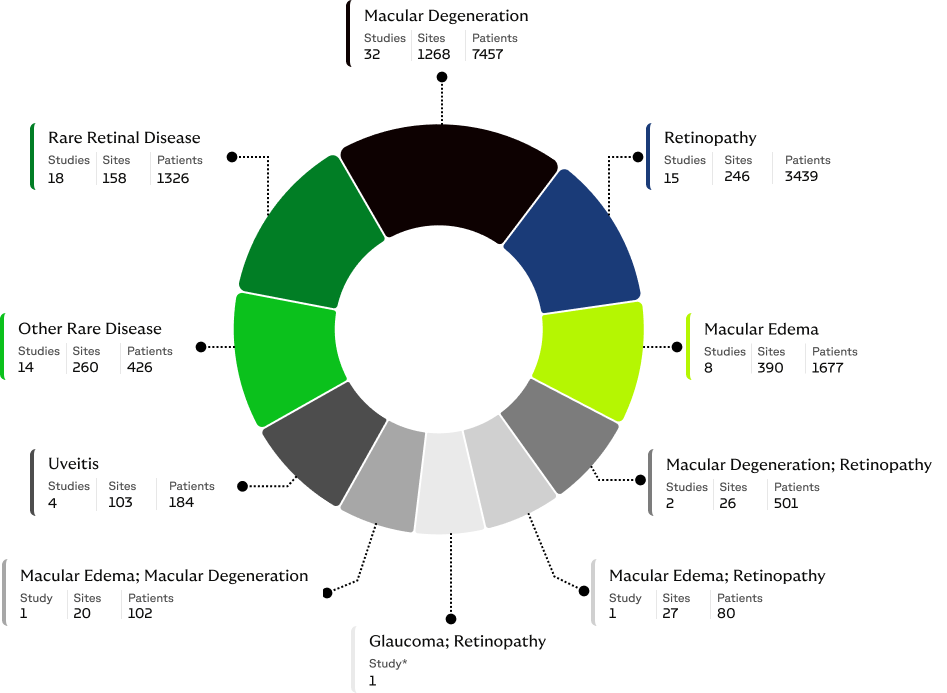
*The data presented range from single service provision to full clinical trial management. Therefore, the number of sites and/or patients may be irrelevant to our services or not disclosed by the sponsor.



Frequently Asked Questions
-
What challenges exist in macular degeneration clinical trials?
Macular degeneration clinical trials face challenges related to slow disease progression, patient variability and the need for sensitive endpoints capable of detecting meaningful visual and anatomical changes over time. Recruiting and retaining appropriate patients can also be difficult, particularly in geographic atrophy and early-stage disease studies where symptoms may progress gradually. In addition, these trials often require extensive retinal imaging, centralized reading centers and long follow-up periods to evaluate treatment durability, safety and clinical benefit.
-
Why is imaging important in retinopathy clinical trials?
Imaging plays a critical role in retinopathy clinical trials by providing objective, quantifiable measures of retinal structure, disease progression and treatment response. Technologies such as optical coherence tomography (OCT), fluorescein angiography, fundus photography and OCT angiography help investigators assess retinal thickness, fluid accumulation, vascular abnormalities and areas of degeneration with high precision. Standardized imaging protocols and centralized image grading also improve data consistency, endpoint reliability and regulatory confidence across multicenter studies.
-
What are the latest breakthroughs in dry macular degeneration treatment?
Recent breakthroughs in dry macular degeneration treatment include the approval and advancement of complement inhibitor therapies targeting geographic atrophy, as well as ongoing development of gene therapies, cell-based treatments and neuroprotective approaches aimed at slowing retinal degeneration. Researchers are also exploring sustained-delivery technologies and novel biologic pathways to improve treatment durability and reduce injection burden. Advances in retinal imaging and biomarker identification are further helping sponsors detect disease progression earlier and optimize clinical trial design.
-
How effective are gene therapies for macular degeneration?
Gene therapies for macular degeneration are showing promising potential, particularly in efforts to provide sustained delivery of therapeutic proteins and reduce the need for frequent intravitreal injections. Many investigational approaches use viral vectors to deliver genes that regulate angiogenesis, inflammation or retinal cell survival, with the goal of slowing disease progression and improving long-term treatment durability. While several programs have demonstrated encouraging safety and biological activity, ongoing clinical trials are still evaluating long-term efficacy, optimal delivery methods and durability of response.
-
How do ophthalmology CROs support research on macular degeneration?
Ophthalmology CROs support macular degeneration research by providing specialized clinical operations, regulatory guidance, imaging management, medical monitoring and site oversight tailored to complex retinal studies. These organizations help sponsors optimize trial design, select appropriate endpoints, manage centralized reading centers and promote consistency in imaging and functional assessments across study sites. Ophthalmology CROs also play a critical role in patient recruitment, investigator training, data quality management and long-term follow-up planning for both device and therapeutic development programs.
-
What latest research is being done on age-related macular degeneration?
Current research in age-related macular degeneration (AMD) focuses on complement pathway inhibition, gene therapy, stem cell therapies, neuroprotection and advanced retinal imaging technologies to improve early detection and treatment outcomes. Investigators are also exploring sustained-release drug delivery systems, artificial intelligence-driven imaging analysis and combination therapies designed to slow disease progression more effectively. In both wet and dry AMD, ongoing clinical trials continue to evaluate therapies that may reduce treatment burden, preserve retinal structure and improve long-term visual outcomes.
Explore our therapeutic depth across the ophthalmology spectrum
Ophthalmology
Personalized ophthalmic services to advance your ocular therapies.
Anterior indications
Streamlining clinical research through collaboration and insight.
Inherited retinal disorders and rare ocular disease
Delivering high-quality, efficient clinical trials for inherited retinal disorders and rare ocular diseases.
Ocular Cell and Gene Therapies
Driving progress in ophthalmology by advancing cell and gene therapies.