Inherited retinal disorders and rare ocular disease
Delivering high-quality, efficient clinical trials for inherited retinal disorders and rare ocular diseases.

Access specialized capabilities to move complex ophthalmology programs forward with confidence and speed.
A focus on rare eye diseases
We provide thoughtful strategies, deep therapeutic know-how and innovative approaches to advance clinical research in rare eye diseases.
Specialized patient recruitment and education
We help your trial reach small and geographically dispersed patient populations and navigate patient recruitment challenges by developing strong relationships that engage and educate sites, patients and patient advocacy groups.
Delivering innovation
We understand the challenges of rare disease ophthalmology trials and apply the proven experience of our operational, medical and functional team to help advance life-changing ophthalmology treatments.

Therapeutically aligned experience
Rare ocular diseases, including inherited retinal disorders, often affect small and widely dispersed patient populations, many of whom are younger and facing progressive vision loss. With limited patients and significant unmet need, we know that every study requires precise planning and efficient execution to deliver meaningful outcomes.
Accessible design to address the patient and caregiver burden
Participation in rare eye disease trials can place a significant burden on patients and caregivers, who often travel long distances to specialized sites and commit to long-term follow-up, particularly in gene therapy studies that require years of monitoring. To reduce burden, improve retention and reduce dropout rates, we incorporate thoughtful trial design, decentralized approaches and patient-centric digital solutions.


Strategic relationships and collaborations
Patients and families affected by inherited ocular diseases are highly informed, deeply engaged and motivated by hope for stabilization or improvement. At the same time, sponsors must manage expectations around experimental therapies, provide robust informed consent and address complex ethical considerations. We develop strategic relationships with key opinion leaders (KOLs), sites and vendors to help accelerate enrollment, enhance protocol adherence and streamline the experience for patients, sites and sponsors across clinical trial development.
Rare ocular disease experience that matters
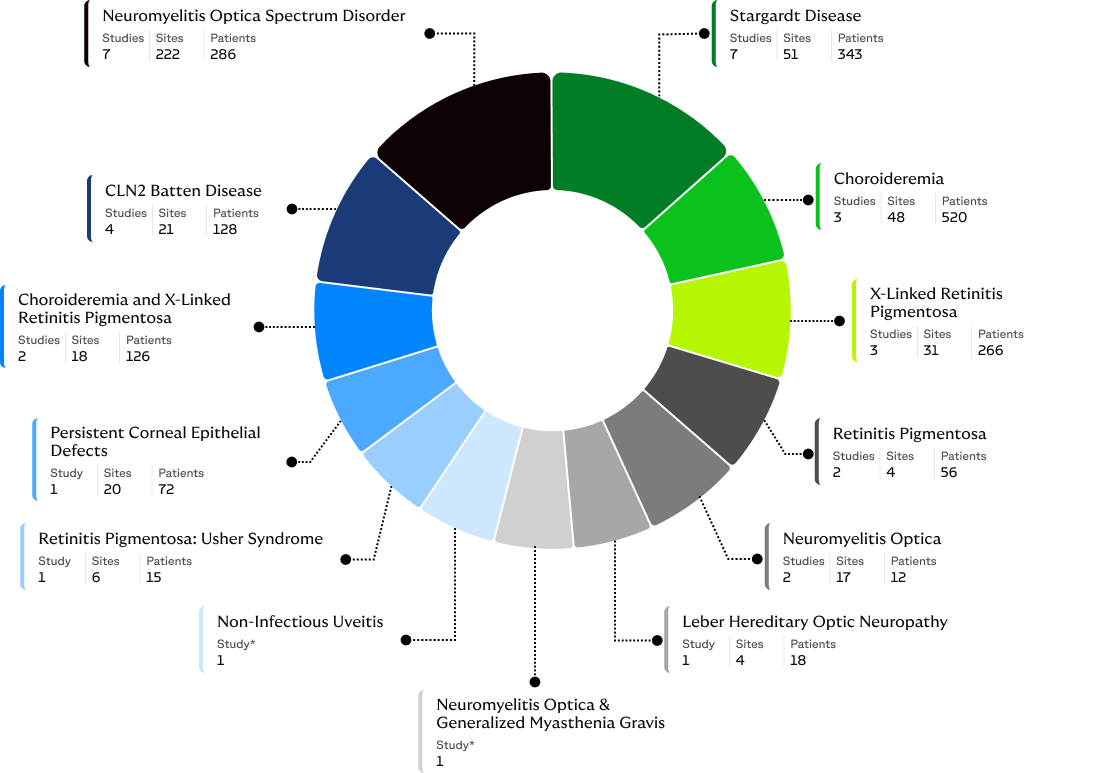
*The data presented range from single service provision to full clinical trial management. Therefore, the number of sites and/or patients may be irrelevant to our services or not disclosed by the sponsor.
Frequently Asked Questions
-
How are patients recruited for rare disease ophthalmology trials?
Patient recruitment for rare disease ophthalmology trials typically involves collaboration with genetic testing centers, academic institutions, patient advocacy organizations and inherited retinal disease registries to identify eligible participants. Because these conditions are often geographically dispersed and underdiagnosed, sponsors frequently use global recruitment strategies, targeted outreach and natural history studies to improve patient identification and engagement. Genetic confirmation, referral networks and strong site relationships are critical to accelerating enrollment and promoting appropriate patient selection.
-
What role does gene therapy play in inherited retinal disease trials?
Gene therapy plays a central role in inherited retinal disease trials by targeting the underlying genetic mutations responsible for progressive vision loss. Most approaches use viral vectors, such as adeno-associated viruses (AAVs), to deliver functional copies of defective genes directly to retinal cells with the goal of preserving or restoring vision. These therapies have significantly advanced the treatment landscape for rare retinal disorders and continue to drive innovation in areas such as gene editing, optogenetics and next-generation vector development.
-
Why is long-term follow-up important in rare eye disease trials?
Long-term follow-up is essential in rare eye disease trials because many therapies, particularly gene therapies, are intended to provide durable and potentially lifelong treatment effects after a single administration. Extended monitoring allows investigators and regulators to assess sustained efficacy, disease progression, durability of response and delayed safety risks such as inflammation or immune-related complications. Long-term data also support regulatory submissions, reimbursement discussions and a better understanding of the natural history and treatment impact in rare ophthalmic diseases.
Explore our therapeutic depth across the ophthalmology spectrum
Ophthalmology
Personalized ophthalmic services to advance your ocular therapies.
Posterior Indications
Advance your ophthalmology study with confidence.
Anterior Indications
Streamlining clinical research through collaboration and insight.
Ocular Cell and Gene Therapies
Driving progress in ophthalmology by advancing cell and gene therapies.